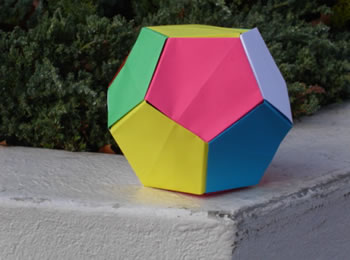
If you follow these instructions carefully, using paper with side lengths in the ratio to 1, you will be able to make a dodecahedron like the one in the picture.
Try it. Then solve the problem.
Note: The standard size office paper, used very widely worldwide (but not in the USA) has side lengths in the ratio to 1 . It is called A4 (bigger sizes in the same proportion A1, A2 and A3, smaller sizes A5, A6 etc.). For this problem, if you are in the USA, you can cut your paper in this proportion.
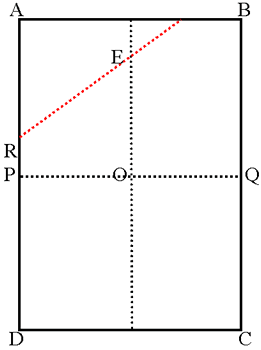
Fold the paper in half both ways to find the centre O. Fold along
the red line so A touches O. Fold C to O similarly. Fold B and D to
O. Next fold along PQ. Tuck the flap from corner D behind the flap
from corner B to make 'pockets'.
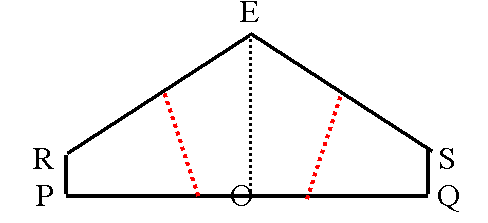
Fold R and S up to the centre line EO to make a pentagon.
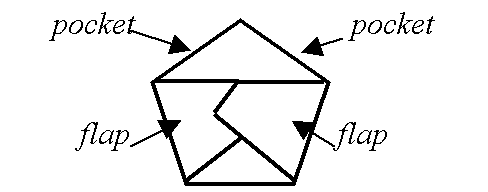
Make 12 pentagons in this way.Assemble them to make a dodecahedron tucking all the flaps into the pockets of adjoining faces.
Prove that when you fold A4 paper in half (to get A5) or in quarters (to get A6) the rectangles you get have side lengths in the same ratio.
If you use A4 paper for this construction and try to make regular pentagons there is a small error in the angle at E. Find this error and find the dimensions of the paper which you would need to use to get an accurate regular pentagon and hence an accurate regular dodecahedron.
Extra Resources:
1) Have a look at the October 2000 Article titled Classifying Solids using Angle Deficiency
2) You can download a demo version of Stella, a computer program which lets you create and view polyhedra on the screen, then print out the nets required to build your own models out of paper. Small Stella and Great Stella are available from the Stella Website.
3) Alternatively, print out the models from this .pdf file or from this one, available at the British Crystallographic Association's Website