Here I re-state the problem but do not change it fundamentally at all, just give it clarity. The original problem uses a multiplicative structure, assumes commutatitivity (though the question is not explicit about this) and essentially everything depends on adding the indices for $x$ and $y$. The underlying mathematics should be transparent not wrapped up unecessarily. I can see no point in the problem as it stood and my suggestion would be to re-write it in an 'additive' form. Matrices can be used to good effect and the whole analysis is really linear algebra. However it is not necessary to use matrices. See below. I use $A$ and $B$ here instead of $x$ and $y$ to connect with Sheep Talk. Instead of the notation $x, y$ and $z$ I connect the analysis to the classical Fibonacci 'rabbit' problem and use the notation: $A$ for 'adult pair' and $B$ for 'non-breeding baby pair' and $C$ for 'child pair'.

The problem might ask you to

(1) Consider a population with two types of members. Let $A_n$ and $B_n$ denote the number of each type at the $n$th stage where:
$$\eqalign{
A_{n+1}&=B_n\cr
B_{n+1}&=A_n+B_n
.}$$
From the above equations $B_{n+2}=A_{n+1} + B_{n+1}= B_n+B_{n+1}$ and so the number of $B$'s in the population grows according to the Fibonacci sequence.

Again, by eliminating the $B$ terms in the above equations: $A_{n+2}=B_{n+1}=A_n+B_n=A_n+A_{n+1}$ so we see that the number of $A$'s in each generation also follows a Fibonacci sequence.

Adding we see that the totals also form a Fibonacci sequence:
$$F_{n+1}=A_{n+1}+B_{n+1}=B_n+A_n+B_n= A_{n-1}+B_{n-1}+A_n+B_{n}=F_n+F_{n-1}.$$

(2) Then consider populations with $3$ types of members where

$$\eqalign{ A_{n+1}&=A_n+C_n\cr B_{n+1}&=A_n+C_n=A_{n+1}\cr C_{n+1}&=B_n.}$$

Historical note: In 1202 Leonardo of Pisa, otherwise known as Fibonacci, published the text Liber Abaci in which he posed the following problem:

A man puts one pair of rabbits in a certain place entirely surrounded by a wall. How many pairs of rabbits can be produced from that pair in a year if the nature of these rabbits is such that every month each pair bears a new pair which from its second month on becomes productive?

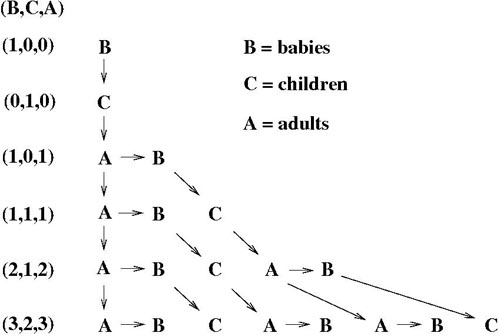
See the tree diagram.[One possibility would be to give the tree diagram in the question and ask the learner to extend the tree for two more generations and to explain how the tree relates to the defining rules governing the changes in population.]

Fibonacci tree diagram Let $A_n$, $B_n$ and $C_n$ denote the number of each type of pairs of rabbits at the $n$th stage, where none of the population dies, $A$-type adults produce babies in the next time interval and $B$-type babies become $C$-type children in the next time interval but the babies do not pro-create. Finally $C$-type children become adults and also produce babies in the next time interval.

From these equations we have $B_{n+1}=A_n +C_n =B_n+B_{n-1}$. So the numbers of $B$'s in the population follow a Fibonacci sequence and as it is given that $C_{n+1}=B_n$ it also follows that the numbers of $C$'s give a Fibonacci sequence. Similarly $A_{n+1}=A_n+C_n=A_n+B_{n-1}=A_n+A_{n-1}$ so the numbers of $A$'s give a Fibomacci sequence.

The total number of all types also give a Fibonacci sequence where:
$$F_{n+2}=A_{n+2}+B_{n+2}+C_{n+2}= A_{n+1}+A_n+B_{n+1}+B_n+C_{n+1}+C_n=F_{n+1}+F_n.$$

The numbers of each type in the $n$th generation can be calculated directly using powers of matrices. The system is given by $F_0=1$, $F_1=1$, $F_{n+2}=F_{n+1}+F_n$ where $n\geq 0$ which can be written:
$$ \begin{pmatrix}
F_{n+2}\\
F_{n+1}\\
\end {pmatrix}
=\begin{pmatrix}
1 &1 \\
1 &0 \\
\end {pmatrix}
\begin{pmatrix}
F_{n+1}\\
F_{n}\\
\end {pmatrix}, $$ which gives
$$ \begin{pmatrix}
F_{n+2}\\
F_{n+1}\\
\end {pmatrix}
= \begin{pmatrix}
1&1 \\
1 &0 \\ \end {pmatrix}^{n+1}
\begin{pmatrix}
F_1\\ F_0
\\ \end {pmatrix}.$$

POPULATIONS WITH $4$ OR MORE TYPES OF MEMBERS

The method can be generalised but there is not much point in the generalisation unless you introduce linear algebra. Then, not only do you get a direct formula for the number in the population for the $n$th generation but also, instead of $0$'s and $1$'s in the matrices, you can introduce probabilities that each type of member will survive to the next generation and also probabilities that they will procreate.