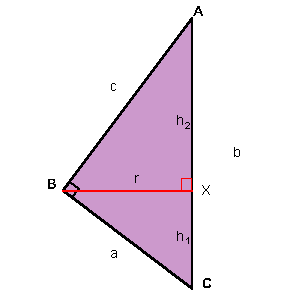
The first thing to observe is that by rotating the triangle about the hypotenuse I obtain two cones having the same base and opposite vertices.
To find the volume of a cone you need its height and the radius of its base. So you need to calculate the radius and the height of each cone.
$$V = \frac{1}{3}\pi r^2 h$$
The radius of the base of the cones is the altitude of the right-angled triangle ($r$), and the corresponding heights are $AX$ and $CX$.
Working directly on the general case - as it seems simpler. Let the sides of the triangle be $a$, $c$ and $b$ ($b$- the hypotenuse).
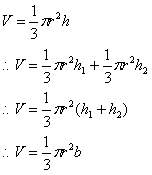
$\begin{eqnarray}V &=& \frac{1}{3}\pi r^2 h \\ &=& \frac{1}{3}\pi r^2 h_{1}+\frac{1}{3}\pi r^2 h_{2}\\ &=&\frac{1}{3}\pi r^2 (h_{1}+h_{2}) \\ &=& \frac{1}{3}\pi r^2 b \end{eqnarray}$
Finding the area of a right-angled triangle in two ways:

Substituting for r in the equation for the volume you get:
|