This excellent solution came from Marcos
from Cyprus.
As I don't have any graphing software I'll be
using the ideas in the question to sketch the
graph at the end. I will try to give as detailed
explanations as I can.
I'm assuming the constant a is positive.
Firstly we show that the graph is symmetrical
about y=x. How do we know if a graph is
symmetrical about y=x? One simple approach is,
if we change the x- and y-axes round and plot
it again we should get the graph looking as it
did in the original case.
(To see this better, think of what happens when
you 'fold' the x-y plane along y=x).
Therefore, since we can swap the axes and
preserve the shape this implies that we can just
check if in our equation we can replace the x
with y and the y with x and still get the
same graph. This is obviously true:
x3+y3=3axy
goes to
y3+x3=3ayx
which is the same thing. Thus, the graphs are
symmetrical about y=x.
Using y=tx in the equation, we get:
x3 + t3x3 = 3atx2.
When x ¹ 0 and t ¹ -1 we can divide by
x2 and 1+t3 and get
x=
3at1+t3
, y=
3at21+t3
.
To find a maximum point we can differentiate
using the chain rule wrt x:
3x2+3y2
dydx
= 3ay + 3ax
dydx
.
Hence
dydx
=
ay-x2y2-3a
.
Now, the maximum is when dy/dx = 0, that is
when ay = x2. Using y=tx gives atx = x2
and when x ¹ 0 this is at x = 3at/(1 + t3)
so 1 + t3 = 3 and thus t=21/3 at the
stationary point. Looking at the parametric form,
this occurs at the point (21/3a, 22/3a).
Putting in an x-value just before and just after
confirms the point to be a maximum.
(a) When t is in -¥ < t < -1 from the
parametric form of the equation x must be
positive and y must be negative.
(b) When t is in -1 < t < 0 then x is negative
and y must be positive.
(c) When t is in 0 < t < 1 then 3at > 0 and
t3 > 0 so x is positive and so is y but as
y = tx then y < x.
(d) Similarly when t > 1, 3at > 0 and 1 + t3 > 0 and so x and y are positive. As y = tx then x < y.
For t=-1 the graph is undefined but as t
tends to -1 the absolute values of x and y
get larger and the graphs get closer and closer
to the asymptote y = -x.
One last aid to sketching the curve is the
following. Is there a point such that y=x?
Considering our equation, 2x3=3ax2 at such a
point. We already know (0,0) is on the graph so
for other points we can divide by x2. We get
x = y = 3a/2 which corresponds to t=1. The
important thing about this point is that
considering our formula for dy/dx if x = y
then dy/dx = -1 and so we know that at this
point the gradient is that of the line y = -x.
This tells us that (as the curve is symmetrical
about y = x and using parts (c) and (d) there
is a 'loop' at this point.
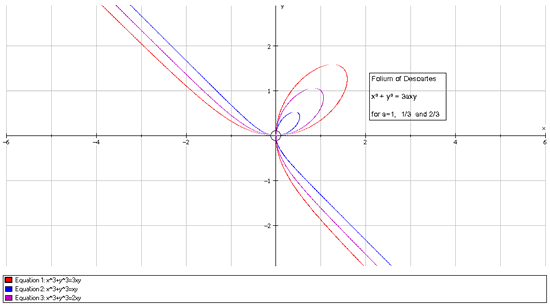
Using all of this
information, we conclude that a sketch of the
graph looks something like this: