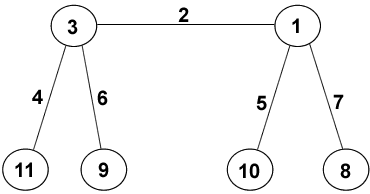
Peter sent us this solution, using the
starting point we gave:
There are 6 vertices and 5 edges. Let's suppose
the magic constant is S and this is the same at
each vertex. The total of all the numbers 1 + 2
+ ... + 11 = 66 but the numbers on the edges,
a,b,c,d,e are counted twice. So, adding the magic sum at all six vertices:
So a+b+c+d+e is a multiple of 6 and it is at
least 1+2+3+4+5=15 so it must be 18 or more.
Hence 6S ³ 84 and S ³ 14.
We're going to call the horizontal edge e, the front two edges a and b,
and the back two legs c and d. Also, we see that the numbers 11, 10 and 9
must all be in feet, as they're too big to be anywhere else.
Let's try S=14 first. We may as well take a=3, as the legs are all
interchangeable at this stage.
Now if b=4, then we have c=5 (as the back legs are interchangeable). Also,
we must have d and the back foot as 6 and 8(in some order), and we soon see
that this isn't possible (as we'd also need e plus the top left hip to add up
to 7). If b isn't 4, then we can assume that c=4. But similarly we find
that we can't have b=9 or b=8 or b=7. So S isn't 14.
Let's try S=16. But then we need four pairs of numbers that sum to 16
(one for each leg). We try: (11,5), (10,6), (9,7), (8,?)and we
can't repeat the 8 so that isn't possible.
So let's try S=15. This time, we may as well take a=4. There are only
4 pairs that add up to 15: (11,4), (10,5), (9,6) and (8,7). Call the number in
the top left hip f.
If b=5, then we have c=6 and e+f=6, which isn't possible (as we don't have
the right numbers left).
So we can take c=5. If b=8, have e+f=3 and then we'll need f+g=4, and
this isn't possible. If b=7, have e+f=4 and we also have f+g=4 and this
isn't possible either. Also we can't have d=8, as this is too big. So the
only possibility is the one shown below (and this does indeed work).
(When I say the only possibility, of course the front legs could be switched,
or the back legs, or the front and back swapped, but it's really the same
caterpillar.)