Correct solutions were received from
Thomas and from Isabelle of Lathallan School. Well done to both!
Here is Isabelle's solution, with diagrams added by the
editor.
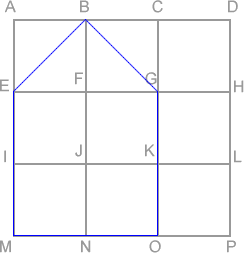
I redrew the pentagon inside a 3x3 grid of 9 small squares (all
the same size). The across lines were ABCD; EFGH; IJKL; MNOP. The
down lines were AEIM; BFJN; CGKO; DHLP. The pentagon was BGOMEB.
(This is shown on the diagram below, with
the pentagon drawn in blue. Can you see why this is the same as
the original pentagon? --Ed.)
As lines EB and BG cut their small squares into halves, the
triangle EBG has the same area as each of the nine small squares.
The rest of the pentagon is 4 small squares so all of it is the
same as 5 small squares. The whole area is 9 small squares so I
need to find a square inside, which is just 4 small squares
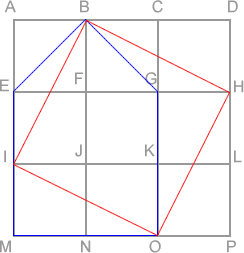
smaller. Then I noticed that if I drew line IO, it would cut the
rectangle IKOM in half, making triangle IMO the same as 1 small
square. Then I saw that I could draw BIOH as a square which is
surrounded by 4 triangles each 1 small square in size.
(This is shown in red on the second
diagram -- Ed.)
So this new square is 9 - 4 = 5 small squares in size. Now I
could see that if I cut out EBI from the original pentagon, it
would fit into BGH, and IMO would fit into OGH. This means that I
could turn the pentagon into a square by cutting along BI and
along IO and simply rearranging the pieces.
A slightly different approach was taken
by Thomas, whose solution is given below. Can you see the
similarities and differences between the two ways of solving the
problem? (Again, the editor has added diagrams.)
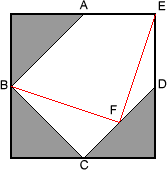
From the midpoint of the left side of the square, draw a line to
the midpoint of the diagonal connecting the bottom and right
sides (BF). From this point, draw the second line to the upper
right corner of the square (FE).
Why? 3/8 of the square is lost when the triangles are cut away, so,
assuming a unit square, the area of the pentagon (and subsequent square) is
5/8; this requires a new square with sides of length
.
The first line makes a triangle (BCF) that,
once flipped over
and placed with BC along edge AB, makes a right angle and two
sides of the desired length. We can check that BF is of the right length
using Pythagoras' theorem.
Triangle DEF, formed by the second line,
has a longest side also of the desired length.
We know the lengths
of DE and DF (
and
)
and the
angle EDF between them (135 degrees) and so can use the law of cosines
. This gives
thus
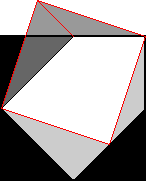
Thus if we move the second triangle so that DE lies along AD, we see that
we have formed a square of side
.
The rearrangement is shown below.