Pythagoras
i.e.
A well presented solution from Deepak of Queen Mary's College Walsall is given below. Correct solutions were also recieved from Andrei of School 205 Bucharest and Calum of Madras College.
Other students from Madras College extended the problem to look at other polygons inscribed inside a circle and a semi-circle. Some of their work follows the solution to the initial problem. This should make you think about what many NRICH problems have lying beneath the skin!! They think they have discovered a pattern - what do you think? My very very many thanks to Thomas Sheila and Elaine and their teacher Ken Nisbet for sending me their work. Keep it up (all I need now is the electronic version!!).
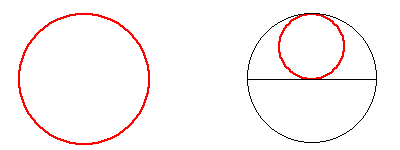
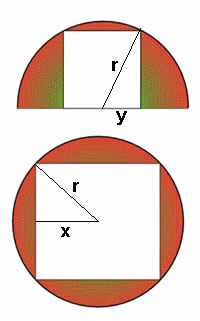
In the first diagram the radius of the circle is r and the side of the square is 2y units
Area of the square is
Pythagoras
i.e.
Thus the area of the square is .
In the second diagram the radius of the circle is r and the side of the square is 2x units.
Area of the square is
By Pythagoras,
i.e.
Hence Area of the square is
So the ratio of the areas is :
That is 4/5 : 2 = 2 : 5
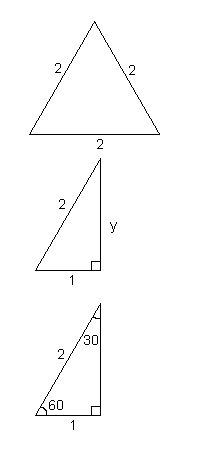
Equilateral triangles by Thomas:
Why can I state cos 30 and sin 30 to the exact answer?
If I split an equilateral triangle of side 2 I will have a right-angled triangle of hypotenuse 2 and base 1 unit.
The angles are 30 o, 60 o and 90 o
By Pythagoras Theorem:
So
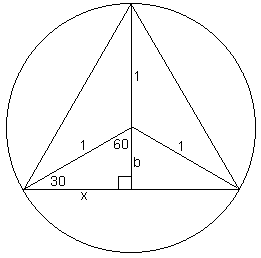
I am able to make the diameter 2 units as all cirlces are
similar.
x = half the base of the equilateral triangle
b = height - 1 (the radius)
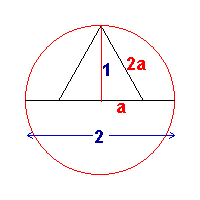
By Pythagoras Theorem
Areaof triangle is
The ratio of the areas:
The ratio is 4:9
Hexagons and more by Sheila and Elaine
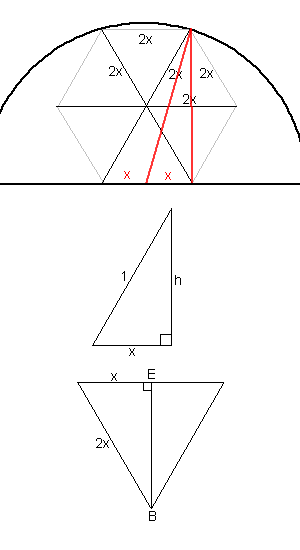
Area of smaller hexagon (in the semicircle)
Suppose the diameter of the circle is 2 (all circles are similar).
The hexagon can be split into 6 equilateral triangles.
Therefore the area of the hexagon = 6 x area of one triangle.
To find the area of the triangles we need to find x.
Taking the red triangle from the diagram, we know that its hypotenuse is the radius of the circle (1 unit) and that h is twice the height of an equilateral traingle.
Using the lower triangle
Now we can find x:
Total area of hexagon = 6 x area of an equilateral triangle
Area =
Area =
Area =
Area =
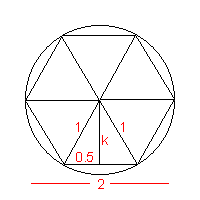
Area of larger hexagon:
The diameter of the circle is still 2 units.
Area of hexagon = 6 x area of an equilateral triangle
So the ratio of the areas is :
That is 4 : 13
| Shapes | Triangle | Square | Pentagon | Hexagon | ....... |
|---|---|---|---|---|---|
| Smaller shape (s) | 4 | 4 | 4 | 4 | ....... |
| Larger shape (b) | 9 | 10 | ? | 13 | ....... |
| Relationship | b=2 1/ 4 s | b=2 2/ 4 s | ? | b=3 1/ 4 s | ....... |
A possible solution to the mystery pattern:
We think the value for the pentagon may be 2 3/ 4.
Using the Fibonacci sequence on the numerator (top nember) of the fractions in the realtionship between b and s would give a ratio between the two areas of the pentagon as 4:11.
If this is the cas we can use this to predict the ratio of the areas of the heptagon and the octagon:
Heptagon 4:16
Octagon 4:21
We couldn't prove this as we didn't have enough time.
What do other members think? I have just a thought to add to this in the form of a diagram...