Several stimulating tilings of the plane can be obtained by considering extensions and modifications to the following procedure:
TO TILE :N
FD :N
REPEAT 3 [RT 15 FD :N]
LT 120 FD :N LT 75 FD :N
REPEAT 3 [LT 15 FD :N]
LT 165
END

Try TILE 40 (say)
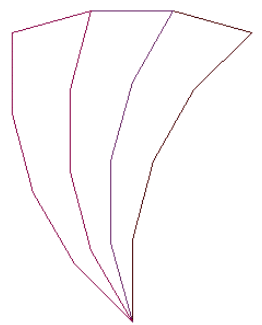
This generates an extraordinary equilateral nine sided tile which can be used to create spiral tilings with one or more arms.
The diagram above shows the start of one such spiral tiling.
Explore the possibilities of this tile and formulate elegant programs to replicate the tilings that you discover.
[Older readers are reminded of the earlier poster designed by Leapfrog's Ltd in the 1980's]
Beginners can start with FIRST FORWARD 1 to 5 here or go back and follow through the series month by month starting from the Introduction to LOGO in July 1999.
TO CIRCLE :CH
REPEAT 360 [ FD :CH RT 1]
END

TO CIRC :CH :ANG
REPEAT 360 [ FD :CH RT :ANG]
END
As a consequence different sized circles and some polygons may have resulted.
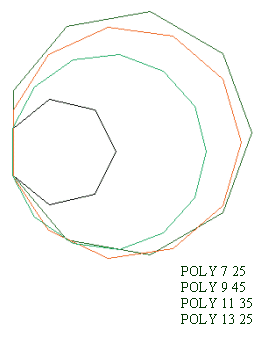
Did any of you manage to draw a heptagon (7- sided)? A nonagon (9-sided)? A endecagon(11- sided)? 13-gon? Etc. etc....
Imagine walking around the outside of a pentagon....as you: go forward then turn, go forward then turn, go forward then turn, go forward then turn, ... finally go forward then turn.
You should be back where you started...go on try it, convince
yourself. In your journey you should have turned through
360o. Five times you turned through
72o.
n.b. 5 x 72 = 360
| Hence:
For a pentagon - REPEAT 5 [ FD 45 RT 360/5] See the pattern? So why not experiment? Go on try:
|
 |
Then try:
TO POLY :N :M
REPEAT :N [FD :M RT 360/:N]
END