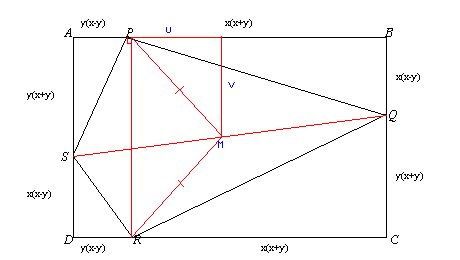
Richard sent us his work on this
problem.
-
We can say that A P S and B Q P are similar triangles (ratio of
sides same),
so in terms of angles:
ÐA P S = ÐB Q P = 180° - 90° - ÐB P Q (angles in triangle add to
180°) =90° - ÐB P Q
ÐS P Q + ÐA P S + ÐB P Q = 180° (angles from
a point
on a straight line add to
180°) Þ ÐS P Q + (90° - ÐB P Q) + ÐB P Q = 180° Þ ÐS P Q + 90° = 180° Þ ÐS P Q = 90°.
-
Same applies again here, triangle Q C R is similar to R D S, and
so in terms
of angles:
ÐC R Q = ÐD S R = 90° - ÐS R D ÐS R Q + ÐC R Q + ÐS R D = 180° ÐS R Q + (90° - ÐS R D) + ÐS R D = 180° ÐS R Q = 90°.
-
As two opposite angles add up to 180°, the other two must as
well
(angles in quadrilateral add up to 360°). Two pairs of opposite
angles each adding to 180° implies a cyclic quadrilateral (one
of
the Circle Theorems).
-
Firstly, as ÐS P Q and ÐS R Q are both 90°,
line S Q must be the diameter of
the circle with midpoint being
centre of circle, M.
As A P R D is a rectangle, ÐA P R and ÐD R P are
both right
angles. Also lines P M = R M, as P and R are on the circle.
Midpoint M is also the centre of the rectangle. Let V be the length
of the perpendicular from M to side A B, and let U be the length
from the foot of this perpendicular to P, as shown in the diagram.
U = [y(x-y) + x(x+y)]/2 - A P = [x y - y2 + x2 + x y]/2 - y(x-y) = [x2 + y2]/2
V = [y(x+y) + x(x-y)]/2 = [x y + y2 + x2 -x y]/2 = [x2 + y2]/2
As U = V, ÐB P M = 45°
Þ ÐR P M = 45° Þ ÐP R M = 45° (isosceles triangle)
Þ ÐP M R = 180° - 45° - 45° = 90°
Þ ÐP Q R = 45° (angle at centre is double that
at edge - Circle
Theorem)
-
As ÐP Q R = 45°
Þ ÐP S R = 180° - 45°
(Cyclic Quadrilateral) = 135°.