There are a few points worth thinking about when you tackle a
problem like this:
- When the solution is given in surds this is really a signal not
to use trigonometric tables or a calculator. One of the problems
with using calculators and tables is that you will calculate
lengths and angles to a certain degree of accuracy (say 10 decimal
places) but even if two numbers are equal to 10 decimal places,
this does not mean that they are equal.
- When you are tempted to use trigonometry and you are not using
angles whose trigonometric ratios can be written easily as surds,
remember that trigonometry is based on the properties of similar
triangles. It is often the case that the most elegant solution in
these situations involves the direct use of similar triangles.
- It is enough that the four sides of a quadrilateral are equal
to be able to say it is a rhombus (why?).
- When you write proofs, try to structure them so that you make
it easy for the reader to follow. Think of "chunking" your proofs
so that each part stands on its own as much as possible.
Jacqui Eaves made a good attempt at this problem and Andrei
Lazanu's work forms the basis of the solution below, well done
Andrei.
The solution
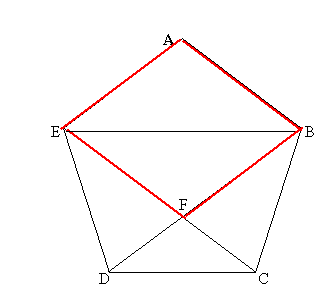
First I calculated the angle between two sides of the
pentagon.
I used the formula for the sum of angles of a regular polygon, with
n sides, that is:
180°(n-2)
For the pentagon, I obtained:
|
180°(n - 2) = 180°(5 - 2) = 180°*3 = 540° |
|
|
Therefore the angle in each vertex is |
540°
5
|
= 108° |
|
|
ÐEAB º ÐABC º ÐBCD º ÐCDE º ÐDEA = 108° |
|
Triangles CDE, DCB and AEB are isosceles (sides of pentagon are
one unit)
|
ÐDEC º ÐDCE º ÐBDC º ÐCBD º ÐAEB º ÐABE = |
180° - 108°
2
|
= |
72°
2
|
= 36° |
|
Then I calculated other sets of equal angles:
|
ÐDFC º ÐEFB = 180° - 2*36° = 108° |
|
|
ÐEFD º ÐBFC = |
360° - 2*108°
2
|
= |
360° - 216°
2
|
= |
144°
2
|
= 72° |
|
|
ÐEDF º ÐBCF = 180° - 36° - 72° = 72° |
|
|
ÐBEF º ÐEBF = |
180° - 108°
2
|
= |
72°
2
|
= 36° |
|
Here are all the measures of the angles that I obtained:
Angles
|
Measures |
|
ÐEAB º ÐABC º ÐBCD º ÐCDE º ÐDEA |
|
|
108° |
|
ÐDEC º ÐDCE º ÐBDC º ÐCBD º ÐAEB º ÐABE |
|
|
36° |
|
108° |
|
72° |
|
72° |
|
36° |
The four sided polygon AEFB is a rhombus because it has all
sides equal (one unit)
Triangles EFB and DFC are both isosceles, their corresponding
angles are equal
I used the following notation:
- DF = x
- FB = 1 (equal in length to the side of the pentagon)
- EB = r
Using the relationship obtained using the similarity of the
triangles, I obtain:
I know that r = x + 1 because triangle BED is also
isosceles.
x and r are the solutions of the following system of two
equations:
I calculate the two numbers, x and r , substituting r from the
second equation into the first. I obtain an equation of the form:ax
2 + bx + c = 0
Which has the solutions:
Solving the equation obtained for x, I obtain successively:
|
x1 = |
2
|
= |
-1 + Ö5
2
|
= |
1
2
|
(Ö5 - 1) |
|
The last solution is not a solution for the problem, because x
cannot be negative, but the first one is. So I proved that
Now I calculate r, that is x + 1.
|
r = x + 1 = |
Ö5 - 1
2
|
+ 1 = |
Ö5 + 1
2
|
|
|
In conclusion: