Many of you have sent in absolutely stunning graph patterns that you have
created using a single graph and transformations of it. You have discovered
how to translate the graph and how to stretch it in different directions by
changing the equation of the graph accordingly. In December we shall
publish a 'gallery' of your patterns. Please continue to send them in and
don't forget to include the equations you have used and your name, age and
school.
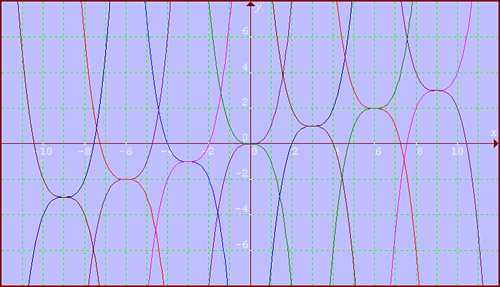
This is Ali Abu-Hijleh's pattern. We gave you two of the equations:
and here are the equations of the other curves:
Well done Hsiu Chen; Claire Phillips, Mount School, York; Malcolm Findlay
and Charles Oliver, Madras College, St Andrew's; Andrei Lazanu, School No.
205, Bucharest, Romania. All these students gave the equations with very
good explanations of their methods as follows:
I started from the graph of the function:
then I identified it on the pattern. I saw that the reflection of this
graph, either in the x-axis or in the y axis, gives:
I displaced these graphs along the x and y axes. I identified the
scale by
looking at the two equations given in the problem. The scale in the drawing
is: x between -12 and 12, and y between -6 and 6.
All the equations are of the form −y ±(x±a)3±b where adding
and subtracting b
translates the graph up and down parallel to the y-axis and changing x
to x±a translates the graph parallel to the x-axis. It happens that in
this example we always have a=3b.