As is often the case when looking for something, you become
distracted by other more exciting ideas. Such was the case recently
when retrieving some old tiling patterns.
How could I have overlooked the Penrose tile? A very special
tile named after its inventor - Sir Roger Penrose OM, until
recently the Rouse Ball Professor of Mathematics at the University
of Oxford. He is also a well-known populariser of mathematics.
The Penrose tile is a rhombus whose side length is
f
(phi - the Golden section) and whose interior angle
is
72°
. The tile is cleverly dissected into what John
Conway - another well-known populariser of mathematics, calls
'darts' and 'kites'.
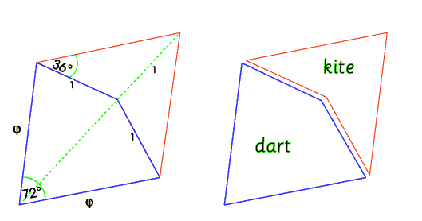
These two shapes can be used to tile the plane in very
interesting and stimulating ways, as illustrated below:
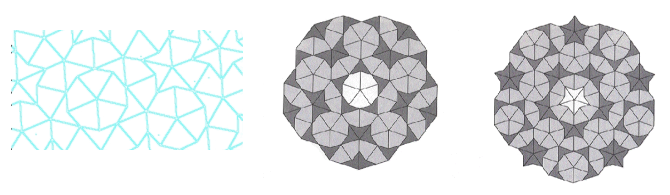
Can you, by first defining the kite and dart
within the context of LOGO, devise elegant programs to replicate
the tilings above?
 |
See the website
of Pentaplex Ltd. for details of some games and jigsaws based
on these tilings.
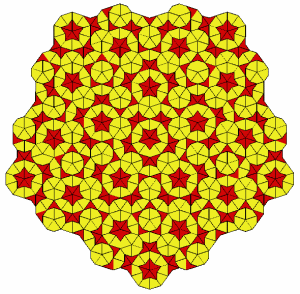
There is an article about these tilings by Bill Richardson in
the January 2000 edition of Maths in School, published by the
Mathematical Association. Bill has sent us this image showing much
more of the second tiling pattern above. You might like to try to
re-produce it using LOGO.
|
FIRST FORWARD
Beginners can start with FIRST FORWARD 1, 2 and 3 here or go
back and follow through the series month by month starting from the
Introduction to LOGO in
July 1999 .
Last month you investigated the instruction:
REPEAT 360 [FD 1 RT 1]
Hopefully you altered it as you saw fit and produced some
exciting shapes.
So it is timely to introduce you to the idea of a variable. As
the word implies, a variable is something that varies, something
that changes.
You may find the following a quicker way of drawing circles and
circular patterns. It is called a procedure and has to be written
in a particular way.
TO CIRCLE :CH
REPEAT 360 [ FD :CH RT 1]
END
Notice how the procedure is set out:
| First a title / a command; |
TO CIRCLE then the variable :CH |
| followed by the instructions; |
REPEAT 360 [ FD :CH RT 1] |
| then a formal closing of the procedure. |
END |
N.B. the variable, :CH could have been any letter or letters
that you wish!
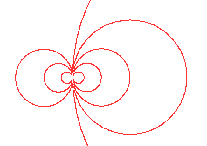
However experiment with the procedure:
CIRCLE 3
CIRCLE 6
CIRCLE -3
CIRCLE 9
|
 |
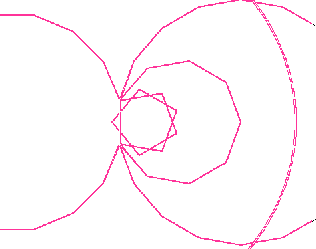
Building on this idea of a procedure we could have written:
TO CIRC :CH :ANG
REPEAT 360 [ FD :CH RT :ANG]
END
This is a procedure with two variables!
Can you anticipate what will change and what will happen now?
Can you see what is now possible?
Go on experiment! Try:
CIRC  3 3
CIRC  3 6
CIRC  3 30
What is happening?
Why not be bolder and try say:
CIRC 30 90
CIRC 30 45
CIRC 30 18
Etc., etc.,
|
 |
What do you notice?
What conclusions can you come to?