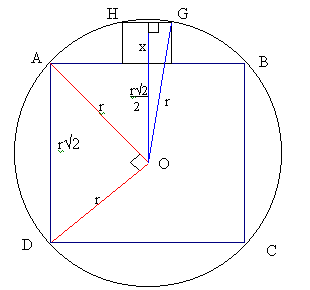
Well done Freddie Manners (Packwood Haugh School) for this solution of the first part of the problem. Perhaps someone else can solve the second part.
If the radius of the circle is r, the length of each side of the square r√2 (Pythagoras' theorem).
Take a triangle from centre of circle to mid-point HG, mid-point HG to H, and H to centre. This is a right-angled triangle.
If the length of the sides of the small square is x, the sides of this triangle are:
1/2 x, x + r√2/2 and r
By pythagoras,
Substitute y = r√2 (length of the side of the large square)
ratio must be positive, therefore 10x = 2y, therefore y =
5x
QED
Solution to part B.
Submitted by Samantha Gooneratne, Colombo International School, Sri Lanka. Well done Samantha! Her teacher also solved the problem using similar triangles, which I have include below Samantha's solution.
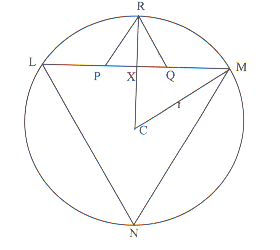
Let X be the mid point of PQ, C the center of the circle and r the radius.
| RX + XC = r Hence PR sin 60 o + CM cos 60 o = r Therefore Now
|
 |
Solution using similar triangles:
NR is a diamter so NLR = 90 o
but NLM = 60 o so RLP = 30 o
Now LPR = 120 o so LRP = 30 o
Hence LP = pr but PR = PQ
so LP = PQ = QM
LM = 3 PQ