We have received solutions from Ali from Riccarton High School in Christchurch, New Zealand, from Luke from Cottenham in Cambridgeshire, from Thomas from St Peter's College in Australia, from Andrei from School 205 in Bucharest, Romania and from Robert from Forres Academy in Scotland.
The ten digit number we were after is:
3816547290
since
3 is divisible by 1
38 is divisible by 2
381 is divisible by 3
3816 is divisible by 4
38165 is divisible by 5
381654 is divisible by 6
3816547 is divisible by 7
38165472 is divisible by 8
381654729 is divisible by 9
3816547290 is divisible by 10
Ali worked it out like this:
Since the number formed by the first 5 digits from the left is divisible by 5, E must be 5 or 0, but since we have used 0 already, E must be 5.
Since AB, ABCD, ABCDEF and ABCDEFGH must be divisible by 2, 4, 6 and 8 respectively, they must all be even. Therefore B, D, F and H must be even numbers.
That leaves 1, 3, 7 and 9 for A, C, G and I.
Ali then started listing the possible combinations, and eliminating those that did not fit:
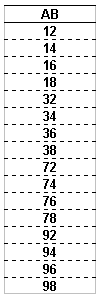
AB could be any of the following:
The number formed by the first 3 digits from the left is divisible by 3, so the digits must add up to a number that is divisible by 3.
The possible values of ABC can now be identified:
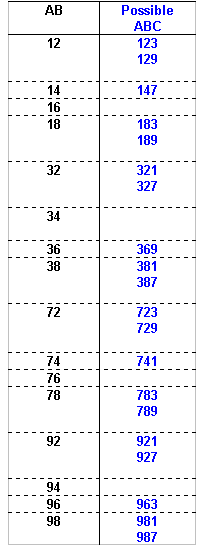
The number formed by the first 4 digits from the left is divisible by 4, so the number formed by the last two digits of the number must also be divisible by 4 (since all multiples of 100 are divisible by 4 we can ignore the digits in the hundreds and thousands column).
The possible values of ABCD can now be identified:
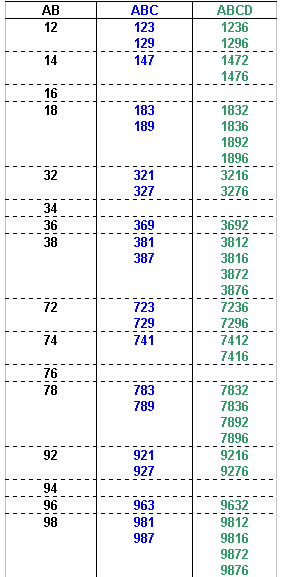
We know that the fifth digit must be 5, so the possible values of ABCDE can now be identified:
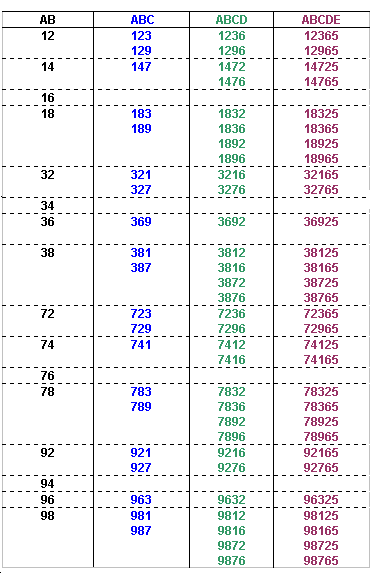
The number formed by the first 6 digits from the left is divisible by 6, so it must be even, and the digits must add up to a number that is divisible by 3 (since it must be a multiple of 3).
The possible values of ABCDEF can now be identified:
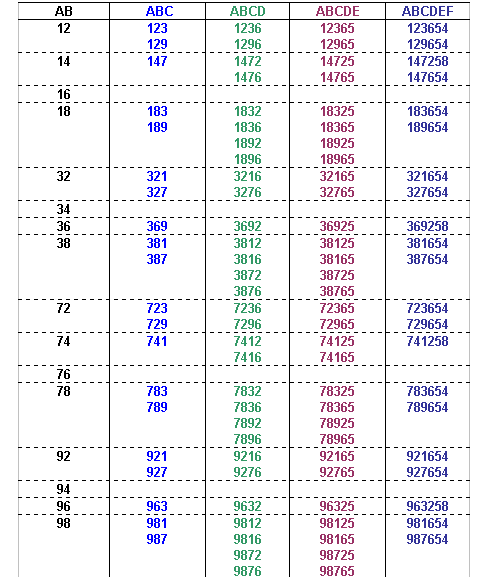
The number formed by the first 7 digits from the left is divisible by 7, and the seventh digit must be odd.
The possible values of ABCDEFG can now be identified:
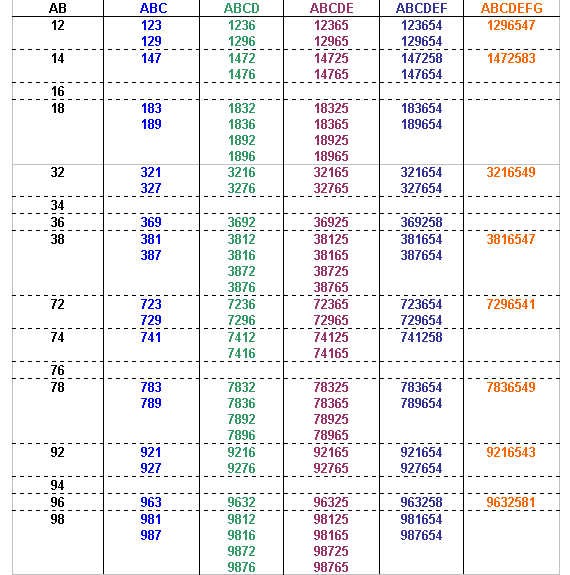
The number formed by the first 8 digits from the left is divisible by 8, so the number formed by the last three digits of the number must also be divisible by 8 (since all multiples of 1000 are divisible by 8 we can ignore the digits in the thousands, ten thousands and hundred thousands column).
That leaves only one option for ABCDEFGH:
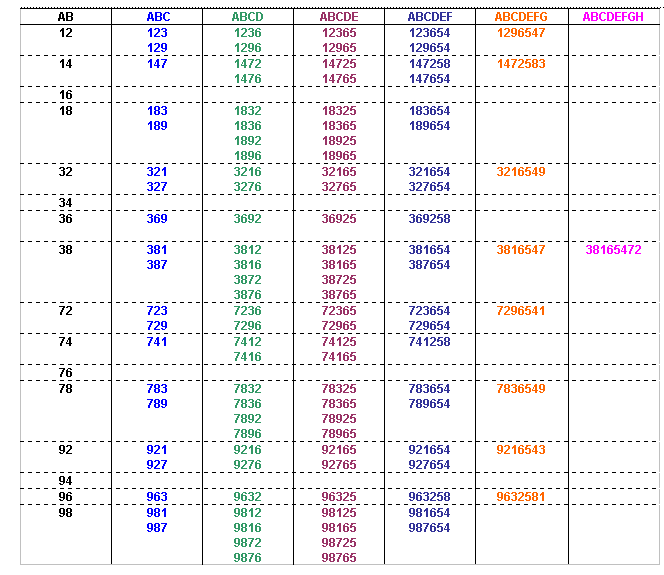
Therefore ABCDEFGHIJ can only be:
3816547290
Luke explained his reasoning like this:
I knew that the last digit was zero because only numbers that have zero at the end are divisible by ten.
xxxxxxxxx0
Numbers that are divisible by 5 end in 5 or 0, and 0 has already been used so the fifth digit must be 5.
xxxx5xxxx0
Since an odd number is not divisible by an even number, the pattern must go odd, even, odd, even,..
The second digit is even and, since multiples of 100 are divisible by 4, the number formed by the first 4 digits from the left will be divisible by 4 if the number formed by the last two digits is divisible by 4,
so, ignoring the first two digits,
we know that the fourth digit has to be 2 or 6 since 14, 34, 74,
94, 18, 38, 78 and 98 are not divisible by 4. (The third digit must
be odd, and not 5).
So these are our options:
xxx25xxxx0
xxx65xxxx0
The sixth digit is even and, since multiples of 200 are divisible by 8, the number formed by the first 8 digits from the left will be divisible by 8 if the number formed by the last two digits is divisible by 8,
so, ignoring the first six digits
we know that the eighth digit has to be 2 or 6 since 14, 34, 74,
94, 18, 38, 78 and 98 are not divisible by 8. (The seventh number
must be odd, and not 5).
Since the fourth digit must be 2 or a 6 as well that means that the second and sixth digits must be 4 or 8.
So these are our options:
x4x258x6x0
x4x658x2x0
x8x254x6x0
x8x654x2x0
This is the bit my Dad helped with. The sum of the first 3 digits must be divisible by 3. Also the sum of the first 6 digits must be divisible by 3. Therefore the sum of the fourth, fifth and sixth digits must be divisible by 3.
So these are our options now:
x4x258x6x0
x8x654x2x0
The first 3 digits must add up to 3.
This gives us the following options:
147258x6x0
741258x6x0
183654x2x0
381654x2x0
189654x2x0
981654x2x0
789654x2x0
987654x2x0
Because the sixth digit is even, and the eighth digit is either
2 or 6,
we can can only have 16, 32, 72, or 96 for the seventh and eighth
digits (they are divisible by 8),
and these numbers can't have been used elsewhere.
The ninth digit can be anything because the sum of all the digits 1 to 9 is divisible by 9.
This gives us the following options:
1472589630
7412589630
1836547290
3816547290
1896543270
1896547230
9816543270
9816547230
7896543210
9876543210
Finally, if we check that the numbers formed by the first 7 digits from the left are divisible by 7, we find that the only possible answer is
3816547290