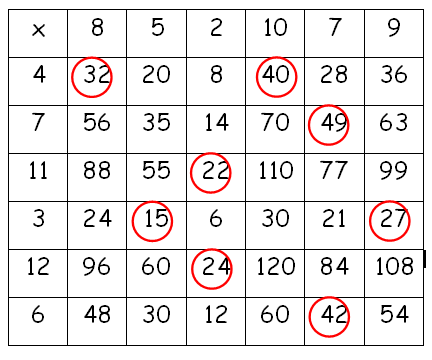
I have to say that I am very impressed by the
number and quality of the solutions you have sent in to this
Mystery Matrix problem. I am afraid I can't mention everyone
individually but special mention must go to pupils at Wharncliffe
Side Primary School, Stourport Primary School, How Wood Primary and
Mount Pleasant Juniors, all of whom sent in well-explained
solutions.
Rukmini from Roberts Elementary School
wrote:
This is my solution to the Mystery Matrix:
I first realized that if you put your finger on a square and track
its row and column, the number in the square would be the product
of the two numbers - the one at the head of the row and the one at
the head of the column.
I knew that each column was part of a multiplication table. I
realized which numbers were needed to multiply to get that
product;
e.g. $32$ was a given number and I knew that $4 \times 8 = 32$, so
I put $4$ and $8$ as the heads of the row and the column. $8$
needed to go at the head of the column and $4$ needed to go at the
head of the row. $40$ was a given number and the head of its column
was $10$. That helped me decide where to put the $4$ and $8$. If I
switched $4$ and $8$ then I wouldn't be able to track $4 \times 10$
to $40$. I knew where to put the $4$ and $10$ because if I switched
them I wouldn't be able to track the $4$ and the $8$ to $32$.
$49$ was the number I tackled first. I knew that $7 \times 7$ was
$49$. So it didn't matter which $7$ I put at the head of the row or
the head of the column.
Then I did $32$ as I already explained.
Then $7 \times 8 = 56$, so I put $56$ in the blank box tracked from
heads $7$ and $8$.
Using the rest of the given numbers I figured out what the rest of
the heads were. I used the heads to help me figure out what the
rest of the numbers were.
Mrs Beacham's class from Round Top Elementary
School, Blythewood, USA also sent a very clear account of the way
they solved the problem with a picture of the finished matrix:
First, we came up with the factors for each number in the
matrix.
We looked at the hint and figured out that $7$ had to be the
repeated digit, because there is only one way to get $49$.
Then we compared the numbers in each row and column where
there were two numbers. For the numbers, $22$ and $24$, $15$ and
$27$, $49$ and $42$ we realized they only had one factor in common.
When we compared $22$ and $24$ we determined that they were both
multiples of two. So $2$ had to go in this column, which meant that
$11$ had to be the missing factor for $22$, and $12$ had to be the
missing factor for $24$. $15$ and $27$ share the factor $3$, so we
placed a $3$ in that row, and above the $15$ we placed a $5$, above
the $27$ we placed a $9$.
For $49$ and $42$, we already knew they shared the factor $7$,
so we thought what times $7$ will give us $42$, and that was
$6$.
The only digits left to use in the matrix were $4$, $8$, and
$10$. When we started, $32$ and $40$ were the hardest to figure out
because these numbers shared more than one factor. If we put the
factor $8$ in the row, that would have meant using the factor $5$
again, so we realized that the factor $4$ had to be placed in that
row. $8$ had to go above the $32$, and we placed $10$ above the
$40$.
Finally, we multiplied the factors in each row and column to
come up with the missing products.
Anhar from Holy Cross Primary School, Oldham,
also sent a very clear explanation of the steps he followed to get
to a solution which are in a slightly different order compared with
those of Mrs Beacham's class:
The first thing I did was work out that $22$ and $24$ are both
in the $2$ times table. I put $2$ at the top of the third
column.
The second thing I did was notice that $49$ and $42$ are both
in the $7$ times table. So I put $7$ at the top of the fifth
column.
The next thing I noticed was that $15$ and $27$ were both in
the $3$ times table. I put $3$ in the fourth row down.
Now I have worked out that $7$ is the fifth column, I know it
must be $7 \times 6$ that equals $42$. So $6$ goes into the bottom
row.
Using the same method we knew $7 \times 7$ equals $49$, so we
put $7$ in the second row down. This also meant that $7$ had to be
the number we used twice.
Now that we know the third column is $2$, we can work out that
$2 \times 11$ equals $22$ and $2 \times 12$ equals $24$. So $11$
goes into the third row and $12$ goes into the fifth row.
Knowing $3$ is the fourth row down, we can work out that $3
\times 9$ equals $27$. So I put $9$ in the last column.
We also worked out that $3 \times 5$ equals $15$, and placed
$5$ in the second column.
We then worked out that $12 \times 2 = 24$, so I placed $2$ in
the third column.
I knew that $8 \times 4 = 32$. However, I did not know which
to put in the column and which in to the row. I then tried putting
$8$ in the column and $4$ in the row. But that would
have meant putting a $5$ in the remaining column, meaning I would
have used $5$ twice as well as $7$ twice. I switched the numbers
around, $4$ to the column and $8$ to the row.
I placed $10$ in the remaining column and completed the number
matrix.
Fantastic! Thank you, Anhar. Finally, Juliet
and Lauren from Whipton Barton Junior School sent in a solution in
which they made it clear that they were using a 'trial and
improvement' approach, which can be a very powerful way of going
about solving a problem like this one. Here is what they wrote:
We solved this problem by working out what could go down the
sides.
First of all we worked with $32$. We did this by thinking of
factors of $32$ and we found $8$ and $4$. We then thought about
other factors of the numbers on the grid. It was pot luck whether
we got the numbers the right way round along the sides at first,
but if we noticed a problem we could change it.
We noticed that $49$ was a square number and we knew that the
two factors timesed together was $7$ times $7$. This meant $7$ was
the only number that appeared twice.
Also, we could fill the middle of the grid in using our times
tables facts.
Once again, thank you to everyone who sent in
a solution which explained your method.