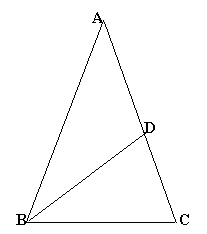
The three triangles are all isoceles
so
ÐBDC = ÐACB = ÐABC.
ÐBDC = ÐBAC + ÐDBA = 2 ÐBAC.
ÐBCD + ÐABC + ÐBAC = ÐBDC + ÐBDC + ÐBAC = 180o.
2 ÐBAC + 2 ÐBAC + ÐBAC = 180o
5 ÐBAC = 180o ,
ÐBAC = ÐDBA = 36o,
ÐBDA = 108o ,
ÐABC = ÐACB = ÐBDC = 72o
and ÐCBD = 36o.
The triangles ABC and BDC have lengths AB = AC = p
and BC = BD = DA = q and the angles are 36o , 72o and 72o
so they are similar triangles. Taking the ratio of corresponding sides
AC/BC = BC/DC :
pq
=
qp-q
So p2 -pq-q2 = 0 and dividing by q2
gives the quadratic equation
(p/q)2 -(p/q)-1=0
which has the solutions (1 ±Ö5) /2. We don't want the
negative root for such a ratio as it would make no sense. Hence p/q = (Ö5 + 1)/2 . Similarly q/p = (Ö5 - 1)/2 .
Triangles ABC and BDC are similar and the ratio of areas
is the square of the ratio of corresponding sides. So area of BDC : ABC
= [(Ö5 - 1)2/2 ] : 1
= (6 -2Ö5 )/4 : 1
= (3 - Ö5 ) : 2
So if the area of triangle ABC is 2 the area of triangle
BDC is 3-Ö5 and the area of triangle ABD is
2 - (3 - Ö5) = Ö5 -1 .