It is not necessary to introduce this investigation starting with the 2- dimensional rectangles. However, these are usually much more familiar than cuboids. With the older pupils there is no need to start with just 2 line lengths. Start with the 3 straight away.
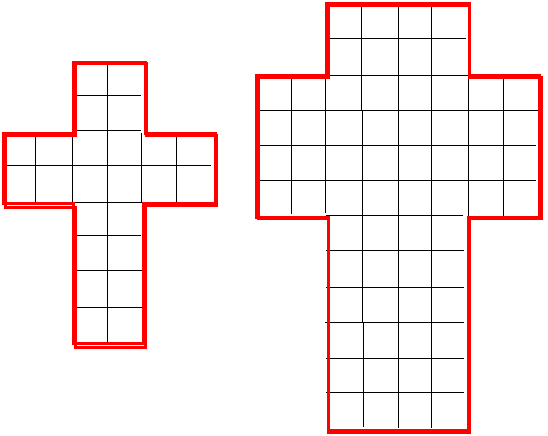
It is helpful for most pupils, whatever their age, to make at least some examples. For those who are younger use 2 cm squared paper - for older pupils 1 cm squared is fine. Fasten them together with tiny pieces of sticky tape - it is a waste of time to make nets with tabs - this is not meant to be a model-making session but an investigation into shape and number. (Beautiful models could be made later for display if required.)
With younger pupils make at least two cuboids beforehand and have the nets available so they can see how they are made up.
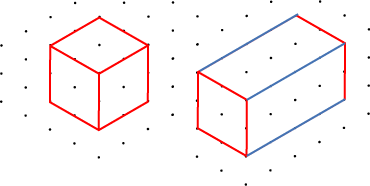
The cuboids can also be sketched on isometric dotty paper.
When introducing the third length point out that the work done beforehand has not been wasted - the cuboids already made are just part of a now enlarged family - just like including all the cousins as well!
Making a list or table is an important and useful way of checking that all possibilities have been included. Pupils should be shown how to do this methodically so that none are included twice, such as 3 x 4 x 2 and 2 x 4 x 3. One way to do this is to list in order of the size of the numbers so that the above example will always be recorded as 2 x 3 x 4.
Arranging the cuboids in order of size can be done either by eye or by working out the various volumes.
Are there any differently shaped ones that are the same size?
This investigation can be extended in a number of ways.
1. Make as many different nets of cubes as you can.
2. Make all the shapes that can be found from 6 adjoining squares and see which can be folded into cubes.
3. Find the pattern:
| 1 length - 1 cuboid |
| 2 lengths - 4 cuboids |
| 3 lengths - ? cuboids |
| 4 lengths - ? cuboids |
This investigation can be extended in a number of ways.
1. Make as many different nets of cubes as you can.
2. Make all the shapes that can be found from 6 adjoining squares and see which can be folded into cubes.
3. Find the pattern:
| 1 length - 1 cuboid |
| 2 lengths - 4 cuboids |
| 3 lengths - ? cuboids |
| 4 lengths - ? cuboids |
4. Find the pattern and compare with 3-D.
| 1 length - 1 rectangle |
| 2 lengths - 3 rectangles |
| 3 lengths - rectangles |
| 4 lengths - rectangles |