This solution is from Chong Ching Tong, Chan Hei Leong, Chen Wei Jian and Ng Yan Shun from River Valley High School, Singapore.
If a + b + c = 4, ab + bc + ca = 6 and abc = 3, then
| 1/a + 1/b + 1/c | = (bc + ac +ab) / abc |
| = 6/3 | |
| = 2 |
| 1/ab + 1/bc + 1/ca | = c/abc + a/abc + b/abc |
| = ( c + a + b )/abc | |
| = 4/3 |
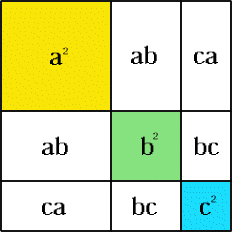
In the diagram the coloured squares have sides of length a, b and c. From the areas in the diagram we get
(a + b + c) 2 = a 2 + b 2 + c 2 + 2ab + 2bc + 2ca.
a 2 + b 2 + c 2 = (a + b + c) 2-2ab + bc + ca = 16 - 12 = 4.
Now think of a cube where each face is cut up in a similar way splitting the cube into 27 smaller cuboids. The volume of the cube is (a + b + c) 3 . We get the formula for the expansion of (a + b + c) 3 by adding the 27 volumes, as given in the table below.
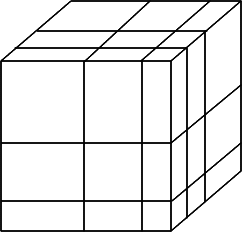
| Top Layer | a 3 | 2a 2b | 2a 2c | ab 2 | ac 2 | 2abc | ||||
|---|---|---|---|---|---|---|---|---|---|---|
| Middle Layer | b 3 | a 2b | 2ab 2 | 2bc 2 | bc 2 | 2abc | ||||
| Bottom Layer | c 3 | a 2c | 2ac 2 | b 2c | 2bc 2 | 2abc |
Adding the volumes we get
(a+b+c) 3 = a 3 + b 3 + c 3+ 3a 2b+3a 2c+3ab 2+3ac 2 +3b 2c+3bc 2+6abc.