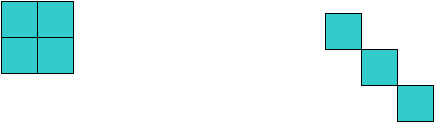
These were the solutions that you realised were easier to illustrate that explain. Some of the diagrams looked different but were either rotations or reflections of the same solution like these the first from Jesse Allen of Tattingstone Primary, the second from Denizhan, Deniz, Cansu and Kaan Year 6 pupils from Mef School, Turkey and Sayomi Ariyas from Victoria, Australia:
Problem 1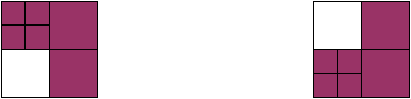
The blank squares represent the squares that are dismantled to remove their sticks for use in another position. This solution to problem 1 was put into words by Mark Webster, "....take the two top (or bottom) right (or left) sticks and put them into the bottom right sector - so that they cross each other at right angles - to make the square divided into four smaller squares.
To move four sticks to create three squares, Alex (aged 9) from Wesley College Melbourne, Australia advised, "....grab the right, bottom, side stick (as well as) the one in the bottom right corner and put them onto the top squares and then the top ones go to the middle ones and you have three squares!" Let's look at that suggestion -
Problem 2changes from 4 to 3 squares
This was the problem people though was tricky and came up with some pretty tricky, and creative, solutions to.
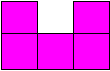 |
Problem 3 Can you see how this change takes place? |
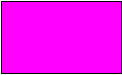 |
Denizhan, Deniz, Cansu and Kaan from Mef School, Turkey, have four squares and a rectangle that they are not including. Jesse Allen suggests putting sticks on top of sticks to leave just three squares like this :
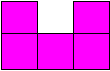 |
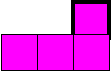 |
Lewis Treacy shows us a solution for turning six squares into two by removing six sticks. Sounds rather impossible, unless you have good visual sense - and many of you proved that you had super sense!
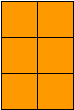 |
Problem 4 from 6 to 2 |
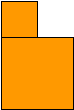 |
Problem 5 from 6 to 6 with 2 removed... but can you see where all 6 are ?? |
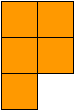
|
Thank you to Dougall from from Wesley College Melbourne, Australia for the solution to Seeing Squares problem number 5. Thanks to David Florence and Stevie Saponja for their contributions to the solutions.