A solution came from Tom of Lexden Primary School
in Colchester, Essex. Tom explains how he set about solving the
problem.
"I worked out what possibilities there were for multiplying
the top two numbers together to equal the middle number. The two
possibilities were 6 and 8 for the middle number.
I then worked out the other outside numbers so that when I
added them altogether they would make 6 or 8. 8 didn't work."
So what did work?
Tom knew, so did Ben
and Thomas both pupils
at Montgomery Church in Wales School, Powys.
They explain: "The middle number has to be 6 because that is
the lowest number that is the one that four of the other lower
numbers can total. That leaves 1, 2, 3 and 0 to be used around
the outside. We multiplied pairs of these numbers together until
we found one pair that made 6. These numbers were 2 and 3."
As Tom said, "The solution won't mirror image top to bottom
because the top two numbers have to multiply to make the middle
number."
Ben and Thomas agreed. They completed the task this way: "1
and 0 were then used to make the diagonal lines total the same
amount."
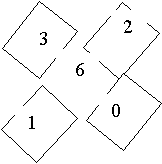
Emma and
Francine found the
same solution. They showed it the same way as Tom.
Well done to each of you. Are there any other series of
consecutive numbers that will allow you to make a similar puzzle?
Abigail who goes to Histon and Impington Infants School sent us
in a very detailed solution to this problem. She wrote:
We named the squares with letters and then we wrote down the
three rules in letters:
A B
C
D E
1. AxB=C 2. D+E=C 3. B+C+D=A+C+E I then made a guess, that if
A=6 and if B=4, C must be 24, but this is too big, so B must be
smaller. I tried B=2 which is still too big, then B=1, but then
C=6, but this is not different to A, so A cannot be 6.
I guessed that A might be 1 and B=2, but then C = 2 too. I saw
that A can't be 1 because then B and C would be the same.
I guessed that A might be 5, and tried B=2, but then C is too
big, but B can't be 1 because A would be the same as C so I
tried another value for A.
I guessed that A might be 3, and B =2 then C=6 which is
possible. I tried other B values.. Not 1, not 3, maybe 4, but
that is too big.
Then I guessed A might be 2. If A = 2 and B=3, C=6 is possible.
If A= 2 and B=4, C=8 is possible. B can't be 5 because C would
have to be 10. B can't be bigger than 5 when A is 2.
I then wrote down what I had found so far.
A = 6 is not possible
A = 1 is not possible
A = 5 is not possible
A = 3 is possible
A = 2 is possible
We could try A = 4, but we don't need to try bigger than 6,
because then C would be too big.
So if A = 4. B could be 2 and C could be 8. But if B is 3, C is
too big.
With all of the possible answers, C is either 6 or 8.
Then I looked at D + E = C. If C = 6
I wrote a table:
D E
1 5
2 4
3 3
4 2
5 1
0 6
6 0
D or E can't be 2 because 2 is already used in A or B. They
can't be 3 because they need to be different. They can't be 6
because that is C.
If C = 8, D and E could be...
D E
0 8 but C=8
1 7
2 6 but A or B = 2
5 3
4 4 but they can't be the same 3 5 6 2 but A or B = 2
7 1
8 0 but C =8
Then Mummy helped me write a big table with all the possible
answers, and I worked out the sums for rule 3:
A B C D E B+C+D A+C+E
4 2 8 1 7 11 19
4 2 8 5 3 15 15 OK
4 2 8 3 5 13 17
4 2 8 7 1 17 13
2 4 8 1 7 13 17
2 4 8 5 3 17 13
2 4 8 3 5 15 15 OK
2 4 8 7 1 19 11
2 3 6 1 5 10 13
2 3 6 5 1 14 9
3 2 6 1 5 9 14
3 2 6 5 1 13 10
So the answers are:
@ 4 2 8 5 3 and
@ 2 4 8 3 5 When I looked at these answers, I noticed that they
are mirror images.
This is fantastic reasoning, Abigail. You have really gone
through the problem in a systematic way.
Well done! Thank you also to Katie, Kirsty, Sam, Lucija, Marek,
Rosie, Sarah, Natasha, Nathaniel and William who told us they
had each found one of the solutions.