Congratulations to Nicola Spittal, S4, Madras College, St Andrew's for your
excellent solution to this problem.
We have four packings of six circles, each of radius
unit that touch their
neighbours and the sides of the box namely:
(A) triangular;
(B) parallelogram;
(C) rectangle (unusual packing) and
(D) rectangle (usual packing).
By superimposing the triangular packing (A) on the parallelogram packing
(B) as shown below we can see that
so that (A) has larger area than (B)
and the difference in areas is equal to the area of the small triangle
.
We use many 30-60-90 triangles with sides in the ratio
. The areas
of the packings are as follows.
Packing (A)
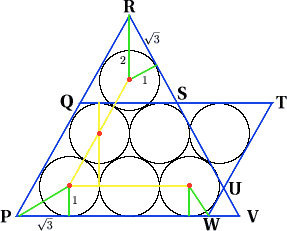
The triangle has side length
so that area is
, or (equivalently, using half base
times height)
, which is 24.12 square units
to 2 decimal places.
Packing (B)
The base length is given by
The height is given by
,
so that the area is 23.55 square units to 2 decimal places.
Packing (C)
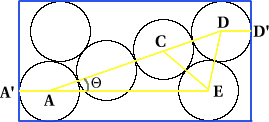
The line joining AE is parallel to the bottom of the rectangle. The base of
the
rectangle
has length
which is
.
Similarly, the height of the rectangle is
.
It remains to find
.
As
is equilateral,
. Using the
Cosine Rule
so that
.
Using the Sine Rule for
,
hence
.
Thus
, and the area is 30.40 square units
to 2 decimal places.
Packing (D) : as the rectangle is
, the area is 24 square
units.