Congratulations to Nicola Spittal, S4, Madras College, St Andrew's for your
excellent solution to this problem.
We have four packings of six circles, each of radius 1 unit that touch their
neighbours and the sides of the box namely:
(A) triangular;
(B) parallelogram;
(C) rectangle (unusual packing) and
(D) rectangle (usual packing).
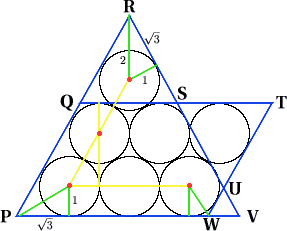
By superimposing the triangular packing (A) on the parallelogram packing
(B) as shown below we can see that
area(DQRS) = area(DSTU) so that (A) has larger area than (B)
and the difference in areas is equal to the area of the small triangle
DUVW.
We use many 30-60-90 triangles with sides in the ratio 1:2:Ö3. The areas
of the packings are as follows.
Packing (A)
The triangle has side length 4+2Ö3 so that area is
1/2(4+2Ö3)2 sin60°, or (equivalently, using half base
times height)
1/2(4+2Ö3)(3+2Ö3), which is 24.12 square units
to 2 decimal places.
Packing (B)
The base length is given by
PW=tan60° +4+tan30° = Ö3+ 4 +
1Ö3
= 6.3094.
The height is given by h = 2+2cos30° = 2 + Ö3 = 3.7321,
so that the area is 23.55 square units to 2 decimal places.
Packing (C)
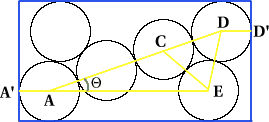
The line joining AE is parallel to the bottom of the rectangle. The base of
the
rectangle
has length AA ' + AD cosq+ DD ' which is 2+6 cosq.
Similarly, the height of the rectangle is 2+6sinq.
It remains to find q.
As DCDE is equilateral, ÐACE = 120 °. Using the
Cosine Rule
AE2
= 16 + 4 - 16cos120° = 28
so that AE = 2Ö7.
Using the Sine Rule for DACE,
sinqCE
=
sin120°AE
,
hence sinq = Ö3/2Ö7.
Thus cosq = 5/2Ö7, and the area is 30.40 square units
to 2 decimal places.
Packing (D) : as the rectangle is 6×4, the area is 24 square
units.