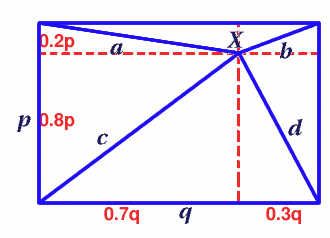
The point X moves around inside a rectangle of dimension p units by q
units. The distances of X from the vertices of the rectangle are a,
b, c and
d units. Using Pythagoras Theorem you can investigate how the value
of a2 + b2 + c2 + d2 changes as the point X moves around in
the rectangle by
finding this value in terms of p2+ q2 for different positions of
the point
X. You could use an entirely algebraic method. Alternatively you would find
a spreadsheet very useful in doing this question and you could investigate
what happens for any particular rectangle. Different members of the class
could take different rectangles and see what happens and you could submit a
joint report from a group.
Suppose for example X is at the point shown in the diagram, then
Ali Abu Hiljeh, age 13 from Riccarton High School, Christchurch,
New Zealand and Tony Cardell and John Lesieutre, age 14 from State
College Area High School, Pennsylvania, USA worked out that the
maximum value, when X is at a vertex, is 2(p2 + q2) and the
minimum value, when X is at the centre, is p2 + q2.
As X moves we have the sides if the rectangle split into lengths
q/2 + x and q/2 - x where x varies from 0 to
q/2 and p/2 + y and p/2 - y where y
varies from 0 to p/2.
a2 + b2 + c2 + d2
= 2
æ ç
è
(
q2
+ x)2 + (
q2
- x)2 + (
p2
+ y)2 + (
p2
- y)2
ö ÷
ø
= 2
æ ç
è
(
q22
+ 2x2) + (
p22
+ 2y2)
ö ÷
ø
(0)
This expression is a minimum when x = y = 0 and it is a maximum
where x and y are both greatest, i.e. x = q/2 and y = p/2. This gives the minimum value of the expression as
p2 + q2 where X is at the midpoint of the rectangle and the
maximum value as 2(p2 + q2) where X is at a vertex of the
rectangle.