Why do this problem?
This problem offers all students opportunities to explore
fundamental ideas about number theory in a simple context. They
are encouraged to explore, conjecture, generalise and justify.
There are opportunities for older students who are familiar
with algebraic manipulation or modulo arithmetic to produce
rigorous proofs.
Possible approach
You need a set of number cards 1-100, with the multiples of 5
removed. Shuffle the cards in front of the class and hand out
one to each student. Do not
tell them that the multiples of 5 are missing!
Ask each student to turn to their neighbour and work out how
to get from one number to the other and back again, using
only these two operations:
$\times 2$ and $-5$
For example if the two numbers are 21 and 54 the chains could
be:
21, double, 42, take five, 37, take five, 32, take five, 27,
double, 54
and
54, take lots of fives, 9, double, 18, take five, 13, double,
26, take five, 21.
Pairs that are proving difficult to connect could be written
on the board and offered as a challenge for the whole class
to solve. Everyone should be able to arrive at
their partner's number!
Finally challenge the class to get to your number (which should
be a carefully chosen multiple of five). You may wish to
offer a prize......
Once the class give up, ask them to explain why it is
impossible.
Display the 1-100 grid, choose 42 as your starting number and
explain that by using the operations above we are going to
try to visit all the numbers on the grid.
Demonstrate how the numbers are crossed out as they are
visited.
Ask the students to predict what will happen.
Will they be able to visit every number on the grid at least
once?
Hand out this 1-100 grid and allow some time for students to
work in pairs to check their predictions.
Bring the students together to link their ideas to the
findings from the earlier exercise.
What would have happened if they had started on a different
number?
Can they explain their results?
Ask if they think they will get the same sort of results with
other pairs of operations.
You may wish to suggest families of pairs of operations for
them to explore. Eg:
x3 and -5
x4 and -5
x5 and -5...
or
x5 and -2
x5 and -3
x5 and -4...
or they can try some families of their own choosing.
Hand out plenty of the
1-100 grids
and ask students to work in pairs or small groups and make a
display of their results.
Can they explain their findings and use these to begin to
make predictions about other pairs of operations? Encourage
them to justify their predictions.
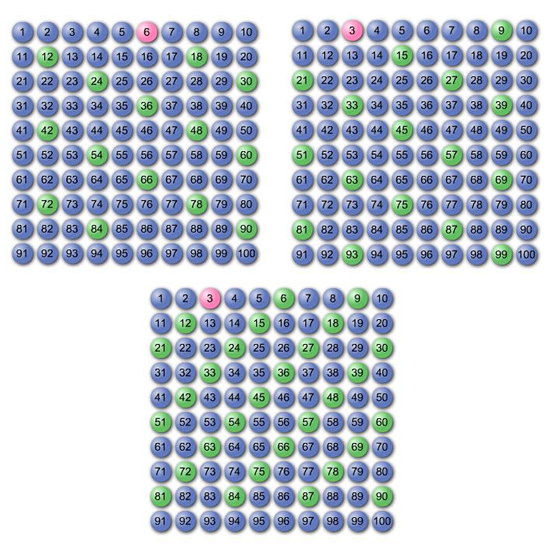
You might find it useful to see if they can identify the pair
of operations that produced the patterns in the three grids
below. They can choose from either:
$\times 3$ and $-6$,
or
$\times 6$ and $-3$
See if they can spot which is which, and if the starting
number makes a difference.
Key questions
What happens to multiples of 5 when they are doubled?
What about numbers that are 1 more, 2 more, 3 more and 4 more
than a multiple of 5?
What happens to multiples of 5 when 5 is subtracted from
them?
What about numbers that are 1 more, 2 more, 3 more and 4 more
than a multiple of 5?
Possible extension
Students could have a go at
Take Three from Five which has a similar underlying
structure. Can they use their insights from the previous
problem to solve this challenge?
Possible support
Most students will have little difficulty with doubling or
subtracting 5, but may find it more difficult to spot the
patterns involved. Using coloured arrows to represent repeated subtractions of 5 on
various 1-100 grids (each starting from a different number) may
help them to see the patterns emerge.