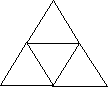
At first this problem seems like a simple counting and shape recognition activity. However, there are a variety of possible explorations suggested by the problem.
The problem can be introduced in a couple of ways. Investigating the different patterns that can be formed by arranging a set of equilateral triangles, can be used as a starting point. Alternatively, at the holiday season many children will be making decorations, the shape can be introduced and coloured in as a decoration and then examined for its interesting properties.
One of the most important aspects of answering the question of how many triangles, is the organisation of the information. How can the children be sure they have included all of the triangles? As strategies are shared draw attention to those that count triangles with sides of one unit, then two units and then three units.
All of the triangles found will be equilateral and rather than ask the children to name the type of triangle it is an opportunity to have them identify the critical properties of the triangles they find. Ask if the triangles are the same shape and prompt children to explain how they could prove their answers. This allows the discussion and exploration of several important concepts: angles, measurement of equal sides and congruence (exactly the same shape and size). When asked what is different about the triangles found, children are determining the properties of similarity (the same shape but different size). These concepts can be further investigated through using attribute blocks (when size is one of the attributes) or other geometric shape or pattern blocks.
The star has symmetrical properties. These can be investigated using a mirror to find the axis or line of reflective symmetry. Provide one green equilateral triangle shape to each of the children and ask them to draw their own star. This activity can lead to questions about how the shape is turned or moved across the paper to make the shape. This enables you to offer opportunities for the children to have practical experiences with rotations or turns, reflections or mirror images and transformations or slides.
Children can create a more complex shape by using four small equilateral triangles to create each of the original triangles. Can they estimate how many triangles are contained within the new complex figure? Based upon their earlier experience, encourage the children to come up with a systematic plan for finding the total number of triangles.