Meg offers this solution:
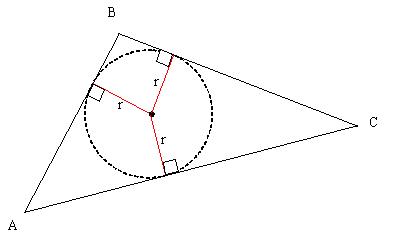
The tangent of a circle is at right-angles to the radius of the
circle. That is, if you join the centre point of the circle to a
point where the circle meets the outer triangle, it makes an
angle of
90 ° with the side of the triangle.
The bisector of the angles of triangle ABC will all pass through
the centre of the circle.
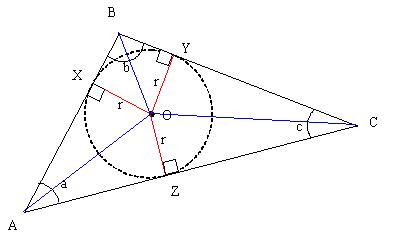
From this we know that
and OZA = 90 °
Hence
Now consider triangle XOZ. THis triangle is isosceles,
so
| OXZ = XZO = |
180-(180-a)
2
|
= |
a
2
|
|
By similar arguments
and
Hence the new angles of the triangle are
a+b+c=180
Hence
It follows that
.
A similar argument can be followed for XYZ and YZX.
If you continue drawing triangles within circles, the angles will
decrease as shown here:
Triangle 1: a
triangle 2:
triangle 3:
=
triangle 4:
When you continue this iteration, you can demonstrate that the a
term becomes less and less significant, and the sum of the rest
of the terms tends to 60 degrees. Hence the triangle tends to an
equilateral triangle.