This solution was sent in by Ben Pippard, who is in S6 at Madras College in St Andrews. Another good solution was sent in by Nicola Spittal from S4 at Madras College.
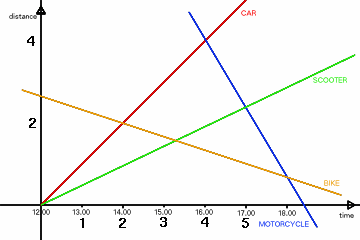
The car overtakes the scooter at 12.00. This point can be taken as the origin of a graph of distance against time.
Assuming that the car travels at 1 unit per hour, the car therefore has equation y=x.
Now assume that the scooter travels at "a" times the speed of the car, where 0 < a < 1. So, it has equation y=ax.
Now for the motorcycle, whose line goes through (4,4) and
(5,5a).
Gradient = (5a-4)/(5-4) = 5a-4
Substituting in the point (5,5a),
To find the intersection of the motorcycle and bike, we know
that x=6.
Therefore y-5a = (5a-4)*1, and so y = 10a-4.
For the bike,
When the bike meets the scooter, y=ax, so 4y=4ax.
Therefore