This first part of this solution came from Dorothy Winn, S4, Madras College,
St Andrew's and the second part from Vassil Vassilev, Y11, Lawnswood High
School, Leeds.
Consider the rhombus as illustrated, where x is an unknown length.
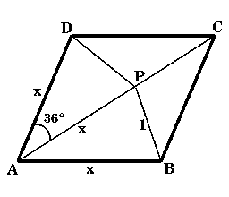
we have to find the value of cos36° cos72° .
I filled in the remaining angles and lengths, showing triangles PCB and PCD
to be isosceles triangles with angles of 108°, 36° and
36° and sides PC = PB = PD = 1 unit.
I found cos36° and cos72 ° by using the cosine rule
for triangles DCP and APD respectively .
|
cos36° = |
x2 + 1 − 1
2x
|
= |
x
2
|
|
|
|
cos72° = |
1 +x2 − x2
2x
|
= |
1
2x
|
|
|
Combining these two expressions,
|
cos36° cos72° = |
x
2
|
. |
1
2x
|
= |
1
4
|
. |
|
Consider the area of the triangle `above' the diagonal, and express
it is the sum of two areas :
|
|
1
2
|
x2 sin108° = |
1
2
|
x·1·sin72° + |
1
2
|
1·1·sin108°. |
|
As sin108° = sin72°, this gives x2=x+1 and hence
Hence
|
cos36° − cos72° = |
x
2
|
− |
1
2x
|
= |
x2−1
2x
|
= |
1
2
|
. |
|
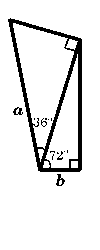
Let the common side of the two triangles be x. Then we have:
b = x·cos72° and
Therefore
|
|
b
a
|
= cos72° cos36° = |
1
4
|
|
|
so a is four times bigger than b.
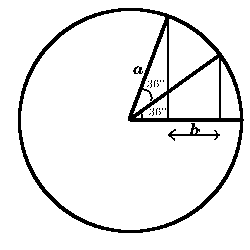
Here we have
and x/a = cos72° so
|
|
b
a
|
=cos36° − cos72° = |
1
2
|
. |
|
Therefore a is twice the length of b.