This is a 'quickie'.
Ling Xiang Ning of Raffles Institution in
Singapore, found two solutions, and after trying some more values
of x, decided that there would be no more because:
"The graphs of $y = x$ and $y = (\sqrt {2})^x$ cut at exactly two
points $(2, 2)$ and $(4, 4)$ so there are exactly two solutions."
Vassil from Lawnswood High School in
Leeds, used a different graph to convince himself that there were
no more solutions.
First of all, he rearranged the equation:
$$ \eqalign { x &=& (\sqrt{2})^x \\ \sqrt[x]{x}
&=& \sqrt{2} }$$ (taking the $x^{th}$ root)
$$ \eqalign { (\sqrt[x]{x})^2 &=& 2 \\ x^{\frac{2}{x}}
&=& 2 } $$ (squaring).
Next he calculated values of $x^{\frac{2}{x}}$ from $1$ to $8$,
and plotted this graph:
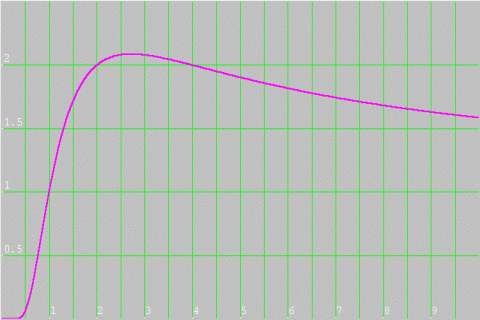
Vassil commented that by looking at the original equation we
could rule out negative values of $x$, and that the values in the
graph decline after $x=4$. The justification for the decline is
that we are calculating smaller and smaller powers. However, you
may not be convinced, as the number we are finding powers
of is getting bigger. Are you sure that curve isn't
going to go up again further along?
The use of a graph to justify there being only 2 solutions was
a good idea.
Clearly $x=0$ is not a solution and there are no negative
solutions because the right hand side is positive. We have
found 2 solutions $x=2$ and $x=4$ and we have to show that
there are no other solutions.
Consider the function $f(x) = (\sqrt 2)^x = exp(x\ln \sqrt 2)$.
Differentiating the function gives: $$\frac{df}{dx} = (ln \sqrt
2)\times exp(x\ln \sqrt 2)$$ and $$\frac{d^2f}{dx^2} = (ln
\sqrt 2)^2\times exp(x\ln \sqrt 2)> 0.$$ So the graph of f
is convex (the first derivative, or gradient, is always
increasing) so the graph of $y=f(x)$ meets $y=x$ in at most 2
points. So $2$ and $4$ are the only solutions.