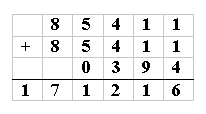
There were several solutions sent in to this problem, which was about substituting numbers for letters. Most people interpreted the problem in the same way, that different letters could not share the same value, in other words H and E had their own value and E could not be the same as H. Well done to each of the solution finders.
Christina Ivanova, from Marlborough Primary School explained her strategy for keeping track of the digits she used and to help her discover the value for each letter. I saw there were 10 different digits which meant there would be 10 different digits. From then on I started guessing the numbers, crossing off the digits as I used them. My final solution was:
Christina's solution was shared by Ece Tugc and Simin Araz (Irmak Primary School, Istanbul, Turkey)
A second solution was found by Sophie and Annabelle (Annesley College, Adelaide, Australia), Sinan Ersanli (from the sixth grade of Irmak Primary School, Istanbul, Turkey) and Ece Demir (also in sixth grade, in the Irmak, Private Primary School). Sophie and Annabelle wrote it out in the following way:
T= 7
H = 4
F = 2
L = 5
R = 6
O = 0
V = 3
N = 8
E = 1
This is the sum with the letters replaced with the digits
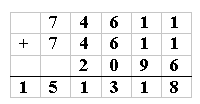
Simin Araz Irmak Primary School, Istanbul, Turkey) found a third solution to the problem:
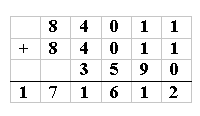
Are there any more solutions that could be found for this problem? Are there any factors that limited the number of solutions possible? Can anybody add to Christina's strategy for finding a value for the letters?