Here's a good clear explanation from Jack Edwards-Fox of Madras College.
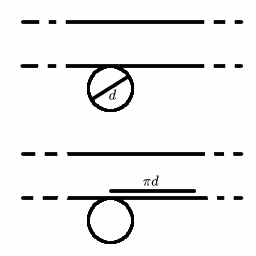
Consider the movement of the block relative to the logs:
When the log makes one revolution it rotates
πd
metres. As the block is in contact with the logs, it
moves
πd
metres along the horizontal plane.
Therefore, the block moves πd metres relative to the logs.
Now consider the movement of the logs relative to the ground:
When the log makes one revolution it rotates πd metres. As it is in contact with the ground it moves πd metres along the horizontal plane.
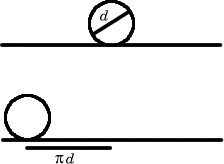
Therefore, the log moves πd metres relative to the ground.
This means the log moves
πd
metres relative to the ground but the block moves
πd
metres relative to the logs. Therefore, the block
moves
2πd
metres relative to the ground, which is twice as
much as the logs. Thus:-
the block moves twice as fast as the logs.