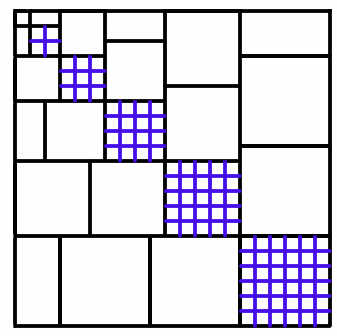
Imagine cubes on each
of the squares marked with a blue lattice, a diagonal
line of cubes of increasing size.
Then take away all the layers except the
bottom ones and spread them out, dividing
them into two groups and arranging them to cover the
whole square.
Start with one cube. Then make a 3 $\times$3
$\times$1 layer by breaking the top layer of a 2
$\times$2 $\times$2 cube in half and putting the
halves on the
edges.
This shows that $1^3 + 2^3 = (1 + 2)^2 $.
Then make a 6 $\times$6 $\times$1 layer by separating
the layers of a 3 $\times$3 $\times$3 cube and
putting the top two layers along the edges.
This shows that $1^3 + 2^3 + 3^3 = (1 + 2 + 3)^2$.