Congratulations to Peter Conlon, age 15, from Worth School in
Sussex. This is Peter's solution.
Given five juxtaposing cyclic quadrilaterals $(C.Q.)$, prove that
the resulting quadrilateral, $EFGH$ in this case, is also a
$C.Q.$ Taken for granted: In a $C.Q.$, opposite angles add up to
$180^\circ$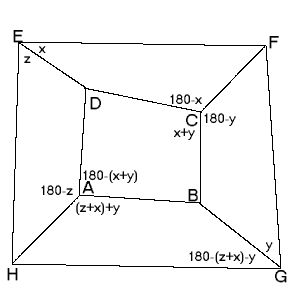
Let $\angle$DEF be $x^o$, $\angle$FGB be $y^o$ and $\angle$HED be
$z^\circ$
Because $CDEF$ is a $C.Q$, $DCF$ = $180^o-x^o$
Because $CBFG$ is a $C.Q, BCF = 180^o-y^o$
Therefore $\angle DCB = (x+y)^o (360^o$ in a circle$)$
Because $ABCD$ is a $C.Q, DAB = 180^o- (x+y)^o$
Because $AHED$ is a $C.Q, DAH = 180^o-z^o$
Therefore $HAB = z^o+(x+y)^o=(z+x)^o+y^o (360^o$ in a circle$)$
Because $ABGH$ is a $C.Q$, $BGH = 180^o-(z+x)^o-y^o$
Therefore $HGF = 180^o-(z+x)^o-y^o+y^o=180^o-(z+x)^o $
But $HEF=(z+x)^o$, and $HEF$ is the opposite angle to $HGF$, and
$HEF+HGF=180^o$
Therefore $EFGH$ is a $C.Q$.