Well done Soh Yong of Raffles Institution, Singapore.
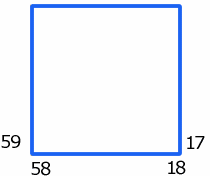
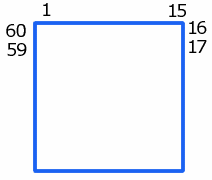
The houses are evenly spaced around a square and numbers $17$ and $59$ are opposite each other. The number of houses must be a multiple of $4$ as there are the same number on each side of the square and so the smallest possible is $60$ with $15$ on each side. This works with $17$ and $59$ one house along from the corner.
For the biggest number of houses, if $17$ and $59$ are on the corners of the square, there are $41$ houses between them, so the largest possible number is $164$.