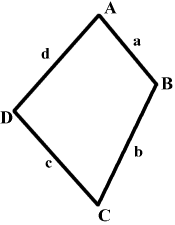
Four rods are hinged at their ends to form a convex quadrilateral with fixed side lengths. Show that the quadrilateral has a maximum area when it is cyclic. Sue Liu from Madras College, St Andrews used two methods to solve this.

METHOD 1
First she applied Brahmagupta's formula for the area of a quadrilateral.


d =
Ö
 

(s - a)(s - b)(s - c)(s - d) - abcd cos2 b
 

where
s = 1
2
(a + b + c + d)

and
b = 1
2
(A + C)

or
1
2
(B + D)

.

Hence the area is clearly the greatest when abcd cos2 b is least. Since cos2 b is always positive, this value is least when b is 90 degrees as cos90o = 0. Hence
1
2
(A + C) = 90

and so A + C = 180 showing that the opposite angles in the quadrilateral add up to 180o and so the area of a quadrilateral with fixed lengths of sides is greatest when it is cyclic.

This method gives a proof of the required result but you have to assume Brahmagupta's formula and Sue's second method uses only the formula for the area of a triangle.

METHOD 2
The area of the quadrilateral ABCD can be expressed as the sum of the areas of triangle ABD and BCD. Let the area of ABCD be D then
D = 1
2
adsinA + 1
2
bc sinC
Thus
dD
dA
= 1
2
adcosA + 1
2
bc cosC dC
dA
.    (1)
From the Cosine Rule,
a2 + d2 - 2adcosA = b2 + c2 - 2bccosC,
Hence, (differentiating both sideswith respect to A),
2adsinA = 2bcsinC dC
dA
.    (2)
From (1) and (2),
frac dDdA
=
1
2
adcosA + 1
2
bc cosC adsinA
bcsinC
=
adcosA sinC + sinA cosC
2sinC
=
æ
ç
è
ad
2
ö
÷
ø
sin(A + C)
sinC
.
Hence, for the maximum area, sin(A + C)=0 and A+C=p which makes the quadrilateral cyclic.

We can show that this gives the maximum and not the minimum value of D by finding the second derivative.