Both Sue Liu, Madras College, St Andrews and Vassil Vassilev, Lawnswood High School,
Leeds solved this one, well done!
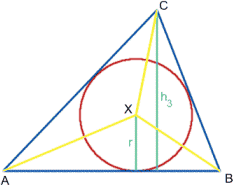
Triangle
has altitudes
,
and
. The radius of
the inscribed circle is
, while the radii of the escribed circles
are
,
and
. We prove that
Let
be the area, of the triangle
and let
be the centre of the
inscribed circle.
Clearly,
so that
Also,
thus
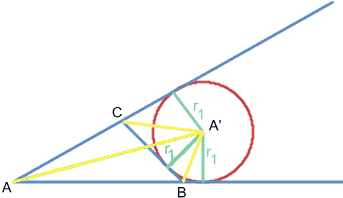
Now let
,
and
be the centres of the escribed circles;
see the diagram below.
Also, for any triangle with vertices
,
and
let
denote its area.
Considering the area of the kite
by splitting it into two triangles
in two different ways we get