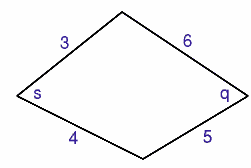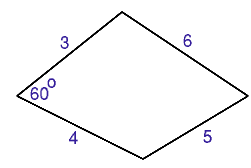
Congratulations to Katharina from the International School in Strasbourg and to Chris from Heckmondwike Grammar School for their solutions to Bendy Quad. Here is Katharina's solution:

To solve this problem I only used one formula which is called the Al Kashi theorem in the country I go to school (France). It is actually an extension of Pythagoras' theorem and is true for every triangle: $a^2 = b^2 + c^2 - 2bc \times \cos (k)$ where $a$ is the side opposite to the vertex $A$ and $k$ the angle at $A$; $b$ and $c$ are the two other sides of the triangle. By transforming it one obtains: $\cos(k) = (b^2 + c^2 - a^2)/(2bc)$.

Take angles $p$, $q$, $r$ and $s$ with $p$ formed by sides 4 and 5 (i.e. the sides with the lengths 4 and 5), $q$ formed by the sides 5 and 6, $r$ by the sides 6 and 3 and $s$ by the sides 3 and 4).
{\bf First part (convex quadrilateral with 60 degree angle):} \\ According to the Al Kashi theorem: $$3^2 + 4^2 -24\cos s = d^2 = 5^2 +6^2 - 60\cos q$$ which simplifies to give $$2\cos s + 3 = 5\cos q.$$ As $\cos s = 0.5$ this gives $\cos q = 0.8$ and $q = 36.9^o$ \par To calculate the other angles, use the Sine Rule to find the two parts of angle $p$ and of angle $r$ cut by the diagonal $d = \sqrt 13$. $ p =132.9^o$ and $r =130.2^o$ (to 1 decimal place). quad 1


quad 2 Second Part (cyclic quadrilateral):
We have found 2coss + 3 = 5cosq. For a cyclic quadrilateral s + q = 180 so cos3s = - cosq. Hence 7cosq = 3 so that q = 64.6o and s = 115.4o.

By drawing the other diagonal and using the same method we find that 45 - 36cosr = 41 - 40cosp which gives
1 + 10cosp = 9cosr.
So cosr = 1/19 giving r = 87.0o and p = 93.0o.

Third Part (general convex quadrilateral)
We proved that 2coss + 3 = 5cosq. Thus (because -1 £ cosq £ 1 for all q) , we have
-4 £ coss £ 1 and  1/5 £ cosq £ 1.
This places no constraint on the value of angle s but it gives 0o £ q £ 78.5o (to 1 decimal place).

Similarly 1 + 10cosp = 9cosr so we have
-1 £ cosp £ 0.8  and  -1 £ cosr £ 11/9.
This places no constraint on the value of angle r but it gives 36.9o £ p £ 180o (to 1 decimal place).

Once one angle is known then the opposite angle is determined from the relations: 2coss + 3 = 5cosq and 1 + 10cosp = 9cosr. Then using the same method as used for the case s = 60 the other two angles are also determined.