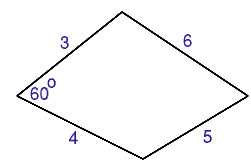
Suppose one angle is 60 degrees as shown in the diagram.
Suppose the angle $s$ is $60$ degrees, then it is easy to
calculate the length of the diagonal and from that to
calculatethe opposite angle in the diagram.
You might like to check your answer by drawing the
quadrilateral accurately, using ruler and compasses only, and
then measuring the angles.
Calculate the other angles of the quadrilateral.
Now calculate the angles of the cyclic quadrilateral formed by
keeping the lengths of the sides the same and changing the
angles so that opposite angles add up to 180 degrees. You might
wish to use a spreadsheet.
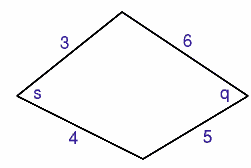 |
The question states that the quadrilateral is convex;
this means that the angles $s$ and $q$ are at most
$180$ degrees.
Imagine moving the rods to make the angle $s$ as
large or as small as possible. Find the largest and
smallest values of $s$ and $q$.
|
To calculate the angles of the cyclic quadrilateral formed by
keeping the lengths of the sides the same and changing the
angles so that opposite angles add up to $180$ degrees you
simply need to use the fact that, in this case, $\cos s = -
\cos q$.