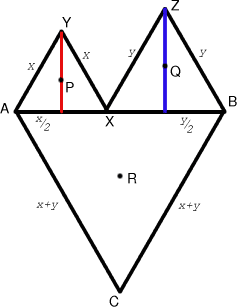
This is Sue Liu's solution proving that the triangle PQR is equilateral
whatever the position of the point X. Many congratulations Sue on all your
excellent work.
Let AX = x and XB = y where we know that AX + XB = AB (constant).
Let the points P, Q and R be the centres (centroids) of the triangles
DAXY, DXZB and DABC respectively.
We use the fact that the medians of a triangle intersect at the centroid and
this point divides the medians in the ratio one third to two thirds.
If we set the point A as the origin, then the points P, Q and R, being
the centroids of the equilateral triangles AXY, XZB and ABC, have
coordinates
P = (
12
x,
Ö36
x),
Q = (x +
12
y,
Ö36
y), and
R = (
12
(x + y),
-Ö36
(x +y)).
We now show that the lengths PQ, QR and RP are equal.
PQ2
= (x +
12
y -
12
x)2 + (
Ö36
y -
Ö36
x)2
=
x2 + 2xy + y24
+
y2 - 2xy + x212
=
x2 +xy +y23
.
QR2
= (
12
(x + y) - (x +
12
y)2 + (-
Ö36
(x + y) -
Ö36
y)2
=
14
x2 +
112
(x2 + 4xy + 4y2)
=
x2 +xy +y23
.
RP2
= (
12
(x + y) -
12
x)2 + (-
Ö36
(x + y) -
Ö36
x)2
=
14
y2 +
112
(4x2 + 4xy + y2)
=
x2 +xy +y23
.
As
PQ = QR = RP =
æ ú
Ö
x2 + xy + y23
for any x it follows that DPQR is equilateral whatever the position of X.